

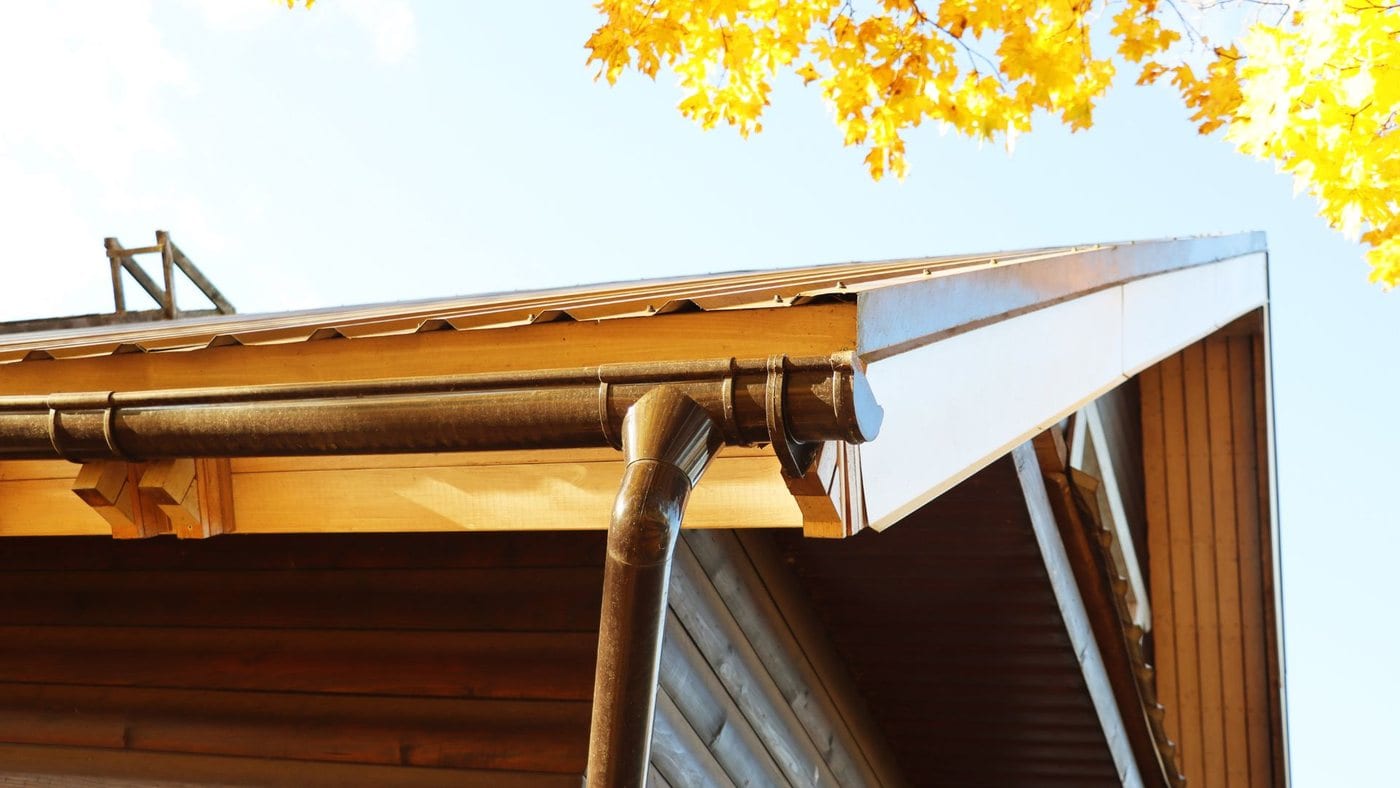
Gutters are the cheapest part of a house to get right and one of the most expensive to get wrong. Everything they fail to carry away ends up at the foundation, in the crawlspace, or soaking the bottom course of siding. NWA Roofing Siding and Gutters installs and replaces seamless aluminium gutters and downspouts throughout Benton and Washington County, rolled to length on site.
Seamless, and why it matters
Sectional gutter from a home centre comes in ten-foot lengths joined with connectors, and every one of those joints is a seam that will eventually leak. We roll seamless gutter on site from a coil, so the only joints on a run are at the corners and the outlets. On a typical Northwest Arkansas house that is the difference between four joints and twenty.
Standard is 5-inch K-style in aluminium, in a range of factory colours. We also install 6-inch, which is not just bigger — it carries roughly 40% more water and pairs with 3x4 downspouts instead of 2x3. On steep roofs, on long runs, and on houses under heavy tree cover, 6-inch is frequently the right call rather than an upsell.
The Ozark rainfall problem
Northwest Arkansas does not get its rain evenly. It arrives in intense spring and early-summer storms that drop a great deal of water in a short window, and a gutter system sized for average rainfall simply overshoots during those events. Water sheets over the front edge, lands in a concentrated line at the foundation, and does exactly what you would expect to the grade, the landscaping and eventually the slab or crawlspace.
Add the region's tree cover — oak and hickory through the Ozark neighbourhoods, plus pine needles in a lot of subdivisions — and half-full gutters become the normal state rather than the exception.
The variables that actually decide whether a system works:
- Sizing. Roof area, pitch and the number of downspouts, not just linear feet.
- Pitch. Gutters need fall toward the outlets. Too little and they hold water; too much and they look wrong and overshoot at the low end.
- Downspout placement and count. The most common failure we find is a long run with one downspout at the far end. It cannot keep up in a real storm regardless of how well it was hung.
- Where the water goes after the downspout. A downspout that empties eighteen inches from the wall has moved the problem, not solved it. Extensions, splash blocks or underground drainage matter as much as the gutter itself.
What we install
- Seamless 5-inch and 6-inch K-style aluminium gutter, rolled on site
- 2x3 and 3x4 downspouts, extensions and splash blocks
- Hidden hangers screwed into the fascia — not spike-and-ferrule, which works loose as the fascia ages
- Fascia and soffit repair where the old system took the wood with it, which is common
- Gutter guards, when they suit the site
- Full tear-off and disposal of the old system
About gutter guards
Guards reduce cleaning; they do not end it. Under heavy oak or pine, fine debris still gets through most designs and shingle grit accumulates regardless. Micro-mesh guards perform best in our experience and cost the most. Cheap plastic screens are usually worse than nothing because they trap debris on top and shed water over the front in a downpour.
What we will not tell you is that guards make a gutter maintenance-free. They make it a job you do far less often and can generally do from the ground rather than off a ladder — which for most homeowners is the actual benefit.
Gutters after a hail storm
Gutters and downspouts are soft metal, so they dent where a roof only bruises. That makes them useful evidence: when an adjuster is deciding whether a storm actually hit the house, the dents in the gutters, vents and window wraps often carry the argument that the shingles cannot make on their own. If we are documenting a roof claim, we photograph the gutters for exactly that reason.
Free estimates. Call (479) 799-2022.